
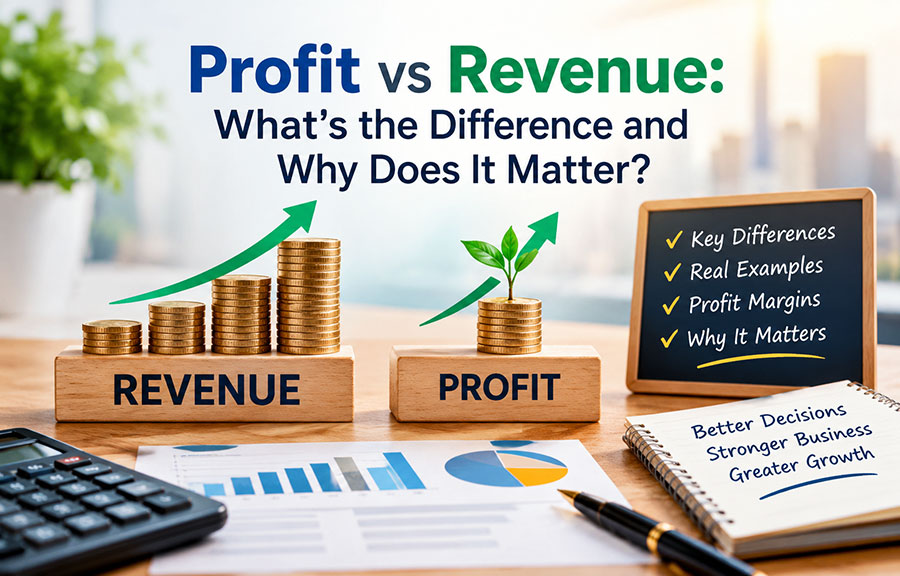
Profit vs Revenue: What’s the Difference and Why Does It Matter?
Revenue and profit are two of the most important numbers in business, but they do not mean the same thing. Revenue tells you how much money a business earns from selling its products or services before expenses are deducted. Profit is what remains after the relevant costs are taken away. Understanding the difference between profit vs revenue can help business owners, freelancers and aspiring entrepreneurs make more informed financial decisions.
Imagine a small business makes sales worth ₹5 lakh in a month. That sounds encouraging, but the business may also have to pay for stock, salaries, rent, delivery, marketing, electricity and taxes. The sales figure alone cannot tell you whether the business is doing well. To understand its financial health, you need to look at both revenue and profit.
What Is Revenue?
Revenue is the income a business generates from its normal activities, such as selling goods, providing services or charging subscription fees. It is often called sales or turnover, although the exact accounting treatment can vary by business and reporting rules.
For example, if a shop sells 500 items at ₹1,000 each, its sales revenue is ₹5,00,000 before any applicable returns, discounts or adjustments. The shop has earned that amount from sales, but it has not yet paid its operating costs.
Common types of revenue
- Sales revenue: Money earned from selling products.
- Service revenue: Fees earned by consultants, agencies, freelancers and other service providers.
- Recurring revenue: Regular income from subscriptions, memberships or ongoing contracts.
- Other income: Earnings from activities outside the main business. Depending on the accounting context, this may be reported separately rather than included in operating revenue.
Revenue helps you understand demand, sales performance and the scale of a business. However, high revenue does not automatically mean that the business is profitable.
What Is Profit?
Profit is the amount left after costs and expenses are subtracted from the relevant income. It gives a clearer picture of whether the business is earning more than it spends under the chosen accounting measure.
Businesses commonly track more than one type of profit because each measure answers a different question.
1. Gross profit
Gross profit is generally calculated by subtracting the cost of goods sold (COGS) from revenue. COGS includes the direct costs associated with producing or purchasing the goods sold. For a service business, the equivalent direct costs depend on how the business accounts for delivering its services.
Formula: Gross Profit = Revenue − Cost of Goods Sold
If a business earns ₹5,00,000 in sales and the goods sold cost ₹3,00,000, its gross profit is ₹2,00,000. This helps show how much is left from sales before other operating expenses are considered.
2. Operating profit
Operating profit reflects earnings from core business operations after relevant operating costs, such as salaries, rent and marketing, are deducted according to the accounting method used. It helps owners assess how well the main business activities are performing.
3. Net profit
Net profit is the amount left after all expenses included in the calculation have been deducted, which may include operating expenses, interest and taxes. The exact presentation depends on the business's accounts and reporting framework.
Simple formula: Net Profit = Total Income − Total Expenses
Net profit is often the figure people mean when they ask whether a business made money. Always check which profit measure is being discussed, because gross profit, operating profit and net profit are not interchangeable.
Profit vs Revenue: Key Differences
| Point of comparison | Revenue | Profit |
|---|---|---|
| Meaning | Income generated from sales or business activities | Amount remaining after relevant costs and expenses |
| Expenses deducted? | Usually shown before expenses are deducted | Yes, depending on the profit measure |
| What it tells you | How much the business is generating in sales or income | How much the business earns after costs |
| Can it be negative? | Revenue from sales is generally not negative, though accounting adjustments can affect reported figures | Yes. A business can make a loss when expenses exceed income |
| Why it matters | Helps track sales, demand and growth | Helps assess cost control and financial sustainability |
A Simple Example: Revenue Is Not the Same as Profit
Suppose a small online business sells products worth ₹5,00,000 during one month. Its simplified monthly figures look like this:
| Item | Amount |
|---|---|
| Sales revenue | ₹5,00,000 |
| Cost of goods sold | ₹3,00,000 |
| Gross profit | ₹2,00,000 |
| Rent, salaries, marketing and other operating costs | ₹1,20,000 |
| Other expenses included in this simplified example | ₹30,000 |
| Net profit before any excluded items | ₹50,000 |
The business generated ₹5 lakh in revenue, but only ₹50,000 remained under this simplified calculation. That is why sales figures alone can create a misleading impression of success. These figures are illustrative, not a complete financial statement; actual accounts may include additional adjustments, interest, taxes or other items.
What Is the Difference Between Profit and Profit Margin?
Profit is an amount of money. Profit margin is a percentage that shows how much profit a business earns relative to its revenue. It can make comparisons between businesses or periods easier, especially when their sales totals are different.
Net Profit Margin = (Net Profit ÷ Revenue) × 100
Using the example above, a net profit of ₹50,000 on revenue of ₹5,00,000 gives a net profit margin of 10%. In simple terms, the business retained ₹10 as net profit for every ₹100 of revenue under the stated calculation.
A higher margin can indicate better cost control or stronger pricing power, but margins vary widely across industries. Compare similar businesses and consider their growth stage, cash needs and accounting methods before drawing conclusions.
Why Do Revenue and Profit Both Matter?
Revenue shows whether sales are growing
Tracking revenue helps a business understand whether more customers are buying, average order values are changing or a new service is gaining traction. If revenue is falling, it may be time to review pricing, customer needs, product quality or marketing.
Profit shows whether the business model is working
A company can increase sales while spending even more to generate them. Monitoring profit helps owners see whether their pricing covers costs and whether the business can support itself over time.
Together, they reveal a more complete picture
Rising revenue with falling profit may signal higher costs, heavy discounting or inefficient operations. Rising profit with flat revenue may point to improved pricing or cost control. Neither pattern tells the whole story by itself, but looking at both numbers helps identify the questions worth investigating.
Can a Business Have High Revenue but Low Profit?
Yes. This can happen when a business has low margins, high operating costs, expensive customer acquisition, frequent discounts, waste or rising supplier prices. Some businesses also deliberately accept low or negative profits for a period while investing in growth, although that strategy requires careful planning and enough funding.
For example, a retailer may sell a large volume of products but earn only a small amount on each sale. If rent, wages, shipping and returns are expensive, very little may remain. High revenue is useful only when the business can turn sales into sustainable earnings or has a clear, well-funded plan for reaching that point.
Can a Business Be Profitable but Still Run Out of Cash?
Yes. Profit and cash flow are related, but they are not the same. A business may record a sale before the customer pays, hold cash in inventory, or use cash to repay loan principal or purchase equipment. These movements can leave the business short of cash even when its income statement shows a profit.
That is why owners should review cash-flow forecasts, customer payment delays, inventory levels, upcoming bills and loan obligations alongside revenue and profit. A profitable business still needs enough available cash to pay suppliers, employees and other commitments on time.
How to Improve Profit Without Ignoring Revenue
- Understand your costs: Review direct costs and operating expenses regularly, and investigate unusual increases.
- Set prices thoughtfully: Consider material, labour, delivery, overhead and customer value instead of copying a competitor's price without analysis.
- Reduce waste: Improve inventory planning, prevent avoidable returns and streamline repetitive work without sacrificing quality.
- Focus on the right customers: Look at repeat purchases, service costs and customer lifetime value—not just the number of new sales.
- Review product and service margins: Identify which offerings contribute most after their relevant costs.
- Track key numbers monthly: Compare revenue, gross profit, operating expenses, net profit, margin and cash flow against your budget.
- Grow sustainably: Check whether extra sales will actually improve profit after the additional costs of fulfilling them.
Cost cutting is not always the answer. Reducing essential maintenance, customer support or employee training may hurt quality and future sales. The aim is to spend wisely and build a business that can deliver value consistently.
Which Is More Important: Revenue or Profit?
Neither number should be judged in isolation. Revenue matters because a business needs customers and income to operate. Profit matters because sales must eventually support costs, investment and financial sustainability. A start-up may focus heavily on building revenue and a customer base, while an established business may place more emphasis on margins and consistent earnings. Both still need to understand cash flow.
The most useful approach is to set goals for revenue, profit margin and cash flow that match the business's stage, industry and financial commitments. Review the trends over time rather than treating one month's result as the whole story.
Common Mistakes to Avoid
- Calling revenue profit: Sales are not the amount the owner can safely take home.
- Looking only at total sales: Revenue growth can hide shrinking margins or rising expenses.
- Confusing profit with cash: Recorded earnings do not guarantee that cash is available today.
- Comparing unlike businesses: Different industries have different cost structures and normal margins.
- Ignoring the time period: Compare like-for-like periods and account for seasonality where relevant.
- Using one profit figure without context: Confirm whether the figure is gross, operating or net profit.
Frequently Asked Questions
What is the simplest difference between revenue and profit?
Revenue is the income a business generates from its sales or activities before expenses are deducted. Profit is what remains after the relevant costs and expenses are subtracted.
Is revenue the same as turnover?
In everyday business language, revenue and turnover are often used to describe sales or income from business activities. Their precise meaning and presentation can vary by jurisdiction, industry and accounting context.
Can profit be higher than revenue?
For an ordinary business calculation using the same period and scope, profit from operations is generally not higher than revenue because costs are deducted from income. However, unusual non-operating gains, subsidies or different reporting definitions can affect comparisons, so check what the reported figures include.
What is a good profit margin?
There is no single ideal profit margin for every business. Margins depend on the industry, business model, scale, pricing and costs. Compare your results with relevant competitors and your own past performance.
Should small business owners track revenue or profit?
They should track both, along with cash flow. Revenue shows sales performance, profit shows what remains after costs, and cash flow helps determine whether money is available when bills are due.
What is the formula for net profit?
A simple version is Net Profit = Total Income − Total Expenses. For formal financial reporting, the exact calculation depends on the applicable accounting standards and which income and expense items are included.
Final Thoughts: Sales Tell One Story, Profit Tells Another
Revenue and profit answer different questions. Revenue shows how much business is being generated; profit helps show how much is left after costs. A company can have impressive sales and still struggle financially if expenses are too high, while a smaller business may be healthy if it manages costs and earns a sustainable margin.
If you run a business, work as a freelancer or are learning the basics of finance, make it a habit to check revenue, profit margin and cash flow together. Understanding these numbers will help you set realistic goals, price your products or services more carefully and make decisions based on the full financial picture—not just the biggest number on the sales report.