
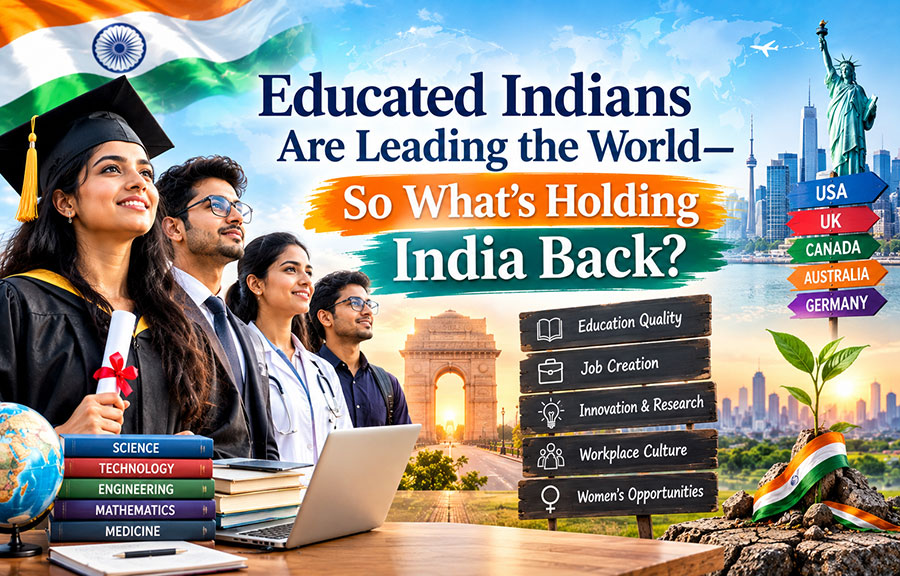
Educated Indians Are Leading the World—So What’s Holding India Back?
Indian professionals, scientists, doctors, engineers, founders, researchers and artists are contributing to businesses and institutions around the world. Yet a difficult question remains: if India has so much talent, why do many educated young people struggle to find the right opportunities at home—or feel that they must move abroad to fulfil their ambitions?
The answer is not that India lacks intelligence or ambition. It is that talent alone cannot guarantee progress. People need strong schools and universities, practical skills, fair access to jobs, well-funded research, reliable public systems and workplaces where good ideas can grow. India’s challenge is to turn its enormous human potential into broad-based opportunity, not merely to celebrate individual success stories overseas.
Indian Talent Is Making a Global Impact
Indians and people of Indian origin are visible across technology, medicine, finance, academia, entrepreneurship and public life. The global Indian community connects the country to research networks, investment, markets and professional knowledge. Many overseas professionals also support families through remittances, mentor students, fund ventures or collaborate with Indian institutions.
This success deserves recognition, but it should not be used to suggest that every Indian graduate has the same opportunities or that success abroad is automatic. Outcomes differ by education, field, family resources, immigration rules and personal circumstances. A strong country makes it possible for people to build meaningful lives whether they choose to stay, return or work across borders.
What Is Holding India Back?
1. A gap between degrees and job-ready skills
A degree can show commitment and subject knowledge, but many employers also need communication, problem-solving, digital fluency, teamwork and practical experience. In some courses, students have limited access to current equipment, internships, live projects or industry mentors. Graduates may therefore hold qualifications yet still need additional training before they can confidently perform a role.
The solution is not to dismiss formal education. It is to connect learning with application: strengthen labs, update course content, expand apprenticeships, teach critical thinking and give students opportunities to build a portfolio of real work. Employers also have a role in explaining what skills they need and providing fair entry-level training.
2. Not enough high-quality jobs for every aspiring graduate
India has a large and ambitious workforce, but the number of young people seeking work can outpace the growth of secure, productive jobs in some sectors and regions. Some graduates accept roles below their qualification level; others prepare for competitive examinations for years because stable employment feels difficult to find elsewhere. Informal work and underemployment can hide the difference between being employed and having a job that uses a person’s skills.
Education policy alone cannot solve this. India also needs a wider base of growing businesses, stronger manufacturing and services, reliable infrastructure, simpler pathways for responsible entrepreneurship, and support for small firms that can create sustainable jobs. Local opportunities matter as much as headline success in a few large cities.
3. Research and innovation need long-term support
Breakthrough research requires more than bright minds. It needs laboratories, grants, modern equipment, time to test ideas, experienced supervisors and a culture where careful experimentation is valued. When research funding is uncertain or administrative processes consume too much time, talented scholars may look for institutions with stronger support and clearer career pathways.
Universities, public agencies and private companies can work together on long-term research programmes, technology transfer and industry-linked doctoral training. Funding should be transparent, peer review credible and researchers encouraged to publish, collaborate and build useful products without compromising scientific integrity.
4. Uneven quality and access in education
India’s education system serves learners with very different resources. A student in a well-equipped urban institution may have access to mentors, laboratories, career counselling and internships, while a student elsewhere may struggle with connectivity, language support, transport or basic facilities. Household income can influence coaching, devices, relocation and the ability to accept an unpaid internship.
Improving outcomes means strengthening foundational literacy and numeracy, teacher development, public institutions, libraries, digital access and career guidance. It also means respecting vocational and technical pathways. A country benefits when students can choose a credible route suited to their strengths rather than feeling that only a narrow set of degrees or examinations counts as success.
5. Workplace culture, pay and career progression
Some professionals consider moving abroad because of salary differences, research facilities, clearer promotion pathways, work-life balance or a desire for greater professional independence. These factors vary by employer and country, so no single explanation fits everyone. But when skilled workers feel under-recognised, face unfair hiring or see limited growth, the loss is felt by teams and institutions as well as individuals.
Organisations can retain talent by offering transparent pay bands, merit-based advancement, respectful management, opportunities to learn, safe workplaces and flexibility where roles allow it. A skilled person should be able to see a future in their career—not only a starting position.
6. Barriers to women’s participation
India cannot fully benefit from its talent if women face avoidable barriers to education and employment. Safety concerns, unequal care responsibilities, inflexible schedules, limited childcare, workplace bias and career breaks can reduce participation or make advancement harder. These are structural challenges, not a lack of ability or ambition.
Safe transport, fair hiring, childcare support, flexible work, equal pay for equal work and transparent promotion systems can help more women enter, remain in and lead across professions. The same principle applies to people with disabilities and learners from underserved communities: talent is widely distributed, but opportunity is not always equally accessible.
7. Bureaucracy and uncertainty can discourage initiative
Entrepreneurs, researchers and institutions need predictable rules and timely decisions. Complex procedures, delayed approvals or uncertainty about funding and regulation can make projects slower and more expensive. Better digital public services, clear accountability and consistent implementation can help people spend more time solving problems and less time navigating processes.
Reform is not simply about removing rules. Good rules protect workers, consumers, the environment and public money. The goal is to make systems transparent, proportionate and reliable so that compliance is understandable and genuine innovation can move forward.
Is Brain Drain Always a Loss?
Migration is more complicated than a simple choice between patriotism and leaving. People move for education, family, safety, income, specialist training or personal fulfilment. Their work abroad can build international relationships, generate remittances and create routes for knowledge exchange. Some return with valuable experience; others contribute to India from overseas through investment, teaching, research partnerships or business links.
The concern arises when people feel they have no realistic choice but to leave because appropriate work, research facilities or professional growth are unavailable. A useful goal is therefore not to prevent mobility, but to make staying, returning and collaborating with India attractive options. Talent circulation can benefit everyone when institutions are open to partnerships and skilled people can find meaningful opportunities.
What Can India Do to Turn Talent into Progress?
- Make education practical: Expand internships, apprenticeships, project-based learning and access to modern laboratories.
- Improve career guidance: Help students understand different pathways, realistic job prospects and the skills employers value.
- Create productive employment: Support firms that grow responsibly, hire locally and invest in worker training.
- Invest in research: Provide predictable funding, strong university-industry partnerships and transparent evaluation.
- Reward competence and integrity: Make hiring and promotion fair, explain decisions and reduce opportunities for favouritism.
- Support women and underrepresented groups: Address safety, accessibility, childcare and discrimination barriers.
- Build international partnerships: Connect Indian universities and companies with global experts, alumni and research networks.
- Respect vocational skills: Give technical, craft, service and applied learning routes credible qualifications and career progression.
- Measure outcomes honestly: Track job quality, wages, placement relevance, research impact and long-term career growth—not just enrolment numbers.
What Students and Professionals Can Do Now
Systemic change takes time, but individuals can strengthen their own options. Choose courses with clear learning outcomes, practise skills through projects, seek internships where feasible and learn to explain your work clearly. Build digital literacy and communication skills alongside your main subject. Use credible career services and verify training providers before paying for a course or placement promise.
Professionals can mentor students, share realistic career advice, collaborate with Indian institutions or support a local business or community project. Those working abroad may contribute through remote teaching, research partnerships, investment or professional networks. These actions do not replace the need for better institutions and public policy, but they help connect individual effort to wider progress.
Reliable Sources for Further Reading
- NITI Aayog — policy research on development, employment and skills.
- Ministry of Education, Government of India — education policy and higher-education information.
- All India Council for Technical Education (AICTE) — technical education and related initiatives.
- Confederation of Indian Industry (CII) — industry perspectives and skills-related reports.
- Indian Council of World Affairs (ICWA) — analysis of international education and student mobility.
Frequently Asked Questions
Why do educated Indians move abroad?
Reasons can include higher pay, specialist education, research facilities, career progression, family ties and quality of life. The reasons differ from person to person and should not be reduced to one explanation.
Does brain drain mean India is losing all its best talent?
No. Migration data and individual experiences are varied. Many people remain in India, return after studying or working overseas, or contribute through international collaborations. The key challenge is ensuring that people have credible choices and that knowledge can circulate.
Is India’s education system failing its graduates?
That is too broad a conclusion. India has strong institutions and expanding educational access, but quality, resources, practical training and career outcomes vary considerably. Improving links between learning and work is an important part of the response.
What skills can improve a graduate’s employability?
It depends on the field, but employers commonly value subject knowledge, problem-solving, communication, teamwork, digital skills, adaptability and evidence of practical work. Students should check the requirements of their target roles rather than relying on generic promises.
How can India attract skilled professionals back?
Clear career pathways, competitive research support, fair recruitment, strong infrastructure, quality public services and opportunities to build ambitious projects can make returning more attractive. International collaboration can also allow professionals to contribute without relocating permanently.
Final Thoughts: Talent Needs an Ecosystem
Educated Indians are helping shape the world, but their achievements should inspire a bigger question: how can India create the conditions for more people to learn, work, invent and thrive at home? The answer lies in more than celebrating exceptional individuals. It requires better connections between education and employment, fair workplaces, research investment, strong public institutions and opportunity that reaches beyond a handful of cities or professions.
India does not need to choose between global success and national progress. With the right systems, talent can move across borders and still strengthen the country through knowledge, investment, innovation and collaboration. The real measure of progress will be whether an ordinary student, wherever they are born, can turn ability and hard work into a dignified and fulfilling future.