
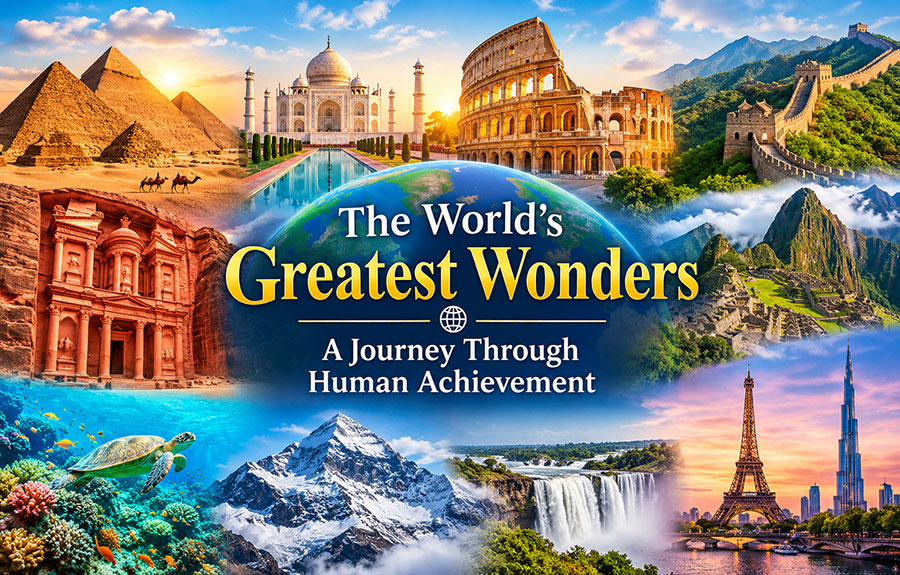
The World’s Greatest Wonders: Extraordinary Places That Tell the Story of Human Achievement
What makes a place truly wondrous? Sometimes it is the scale of a monument, sometimes the skill required to build it, and sometimes the mystery of how it came to exist. The world’s greatest wonders include ancient cities, monumental architecture, extraordinary engineering and natural landscapes that leave visitors with a sense of awe. Each tells a story about the people, cultures and environments that shaped our shared world.
This journey through the greatest wonders of the world explores famous landmarks, ancient achievements and remarkable natural sites. It also looks at why these places matter today—and how travellers can experience them responsibly so future generations can continue to learn from them.
What Are the World’s Greatest Wonders?
The word “wonder” can describe a landmark celebrated for its beauty, scale, historical importance or scientific interest. Some lists focus on human-made structures, while others include natural formations. The familiar Seven Wonders lists are useful starting points, but they are not the only way to appreciate remarkable places. UNESCO World Heritage Sites, for example, recognise cultural and natural locations with outstanding universal value.
No single list can include every achievement or landscape that deserves admiration. Wonders are found across continents, and their significance often becomes clearer when we understand the people who built, protected or lived alongside them.
Ancient Wonders That Still Inspire Us
1. The Great Pyramid of Giza, Egypt
The Great Pyramid of Giza is the only surviving structure traditionally included among the Seven Wonders of the Ancient World. Built during Egypt’s Fourth Dynasty as a royal tomb, it demonstrates extraordinary organisation, surveying knowledge and stone-working skill. Its immense scale continues to inspire questions about the planning, labour systems and techniques used by ancient Egyptian builders. It is evidence of a sophisticated society with strong religious and political traditions.
2. Petra, Jordan
Petra is famous for monumental façades carved into rose-coloured rock, but its achievement extends beyond its dramatic appearance. The Nabataeans developed a major trading centre in a challenging desert environment and created systems for collecting and managing water. The site reveals how architecture, commerce and practical engineering can work together.
3. The Colosseum, Italy
Rome’s Colosseum remains one of the most recognisable examples of ancient Roman engineering. Opened in the first century CE, the amphitheatre was designed to accommodate large crowds and organise public spectacles. Its arches, circulation routes and structural planning show Roman skill in construction and crowd movement. The building also invites reflection on the social values and violence associated with entertainment in the Roman world.
4. The Great Wall of China
The Great Wall is not one uninterrupted wall built in a single period. It is a vast system of fortifications, walls, passes and related structures created and rebuilt by different Chinese states and dynasties over many centuries. Its varied sections reflect changing military needs, geography and construction methods. Its history is best understood as a long-term effort involving many generations.
5. Machu Picchu, Peru
Set high in the Andes, Machu Picchu is celebrated for its stone architecture, terraces and relationship with the surrounding mountain landscape. Associated with the Inca civilisation and built in the fifteenth century, the site shows sophisticated stonework and an understanding of steep terrain. Its precise role continues to be studied, so responsible interpretation avoids presenting every question about the site as settled fact.
Engineering and Architectural Marvels
The Taj Mahal, India
The Taj Mahal in Agra is admired for its balanced design, white marble surfaces, gardens and intricate decorative work. Commissioned by Mughal emperor Shah Jahan in memory of Mumtaz Mahal, it brings together architectural influences and craftsmanship developed across the Mughal world. Calligraphy, inlay, symmetry, landscape planning and the careful use of light all contribute to its beauty.
Angkor Wat, Cambodia
Angkor Wat is one of the world’s most celebrated temple complexes. Built in the Khmer Empire, it combines monumental towers, extensive galleries and detailed stone bas-reliefs. The wider Angkor landscape includes reservoirs, canals and other structures that reflect the relationship between religious life, political power and water management.
The Eiffel Tower, France
Completed for the 1889 Exposition Universelle in Paris, the Eiffel Tower became a symbol of modern engineering and the industrial age. Its exposed iron structure represented a bold departure from many traditional monumental designs. Initially controversial among some observers, it eventually became one of the world’s best-known landmarks.
The Burj Khalifa, United Arab Emirates
Dubai’s Burj Khalifa illustrates the possibilities and challenges of contemporary high-rise construction. Its height required careful planning of structural systems, vertical transport, wind performance and building services. Modern skyscrapers depend on architects, engineers, construction workers and many other specialists. Such projects also raise questions about energy use, urban planning and sustainability.
Natural Wonders That Reveal Earth’s Power
The Grand Canyon, United States
The Grand Canyon’s immense cliffs and layered rock formations expose a long record of geological change. The Colorado River and other processes have helped carve the landscape over vast periods of time. Its deeper wonder lies in the evidence it provides about Earth’s history. Visitors should remain on designated paths and respect safety guidance around steep edges.
The Great Barrier Reef, Australia
The Great Barrier Reef is an extensive marine ecosystem made up of reefs, islands and other habitats. Its biodiversity supports an extraordinary variety of marine life, while its health is connected to ocean temperature, water quality and environmental change. Coral bleaching and other pressures highlight why conservation matters. Visitors can help by choosing responsible operators and avoiding contact with coral or wildlife.
Mount Everest and the Himalayas
The Himalayas were formed through the ongoing collision of tectonic plates and continue to shape weather, rivers and ecosystems across Asia. Mount Everest, the world’s highest mountain above sea level, has become a symbol of exploration and endurance. The region is also home to communities with deep cultural ties to the mountains. Respectful travel recognises local knowledge, fragile environments and the risks of high-altitude activities.
Victoria Falls, Southern Africa
Victoria Falls, on the Zambezi River along the border of Zambia and Zimbabwe, is known for its broad curtain of falling water, spray and rainbows. Its appearance changes with seasonal river levels. The surrounding landscape is ecologically important and culturally meaningful, so visitors should follow local guidance and use authorised viewpoints.
Why These Wonders Matter
World wonders are not just backdrops for photographs. They help us understand how societies organised labour, developed technologies, expressed beliefs and responded to their surroundings. Ancient monuments reveal trade networks and political systems; historic cities preserve layers of everyday life; and natural wonders help scientists study geology, biodiversity and climate.
These places can support local livelihoods through tourism, research and cultural education. However, crowding, pollution, vandalism, unauthorised construction and climate-related pressures can damage sites. Protecting a wonder means respecting both its physical features and the communities connected to it.
How to Plan a Meaningful Visit
- Research before you go: Learn the site’s history, entry rules and seasonal conditions from reliable official sources.
- Choose responsible guides: Local guides can explain cultural practices, conservation concerns and lesser-known details.
- Respect the site: Do not carve names, remove stones, touch fragile artwork or enter restricted areas.
- Travel thoughtfully: Dispose of waste properly and use designated paths and viewpoints.
- Support local communities: Consider locally owned services and authentic crafts from responsible sellers.
- Check accessibility and safety: Terrain, altitude, heat, weather and facilities vary considerably.
- Look beyond the photograph: Read interpretation panels, visit museums where available and learn about nearby communities today.
Are the Seven Wonders the Same as UNESCO World Heritage Sites?
No. The traditional Seven Wonders lists are cultural lists created in different historical periods, while modern “new seven wonders” lists result from particular selection projects. UNESCO World Heritage status is a separate process based on defined criteria and international agreements. A place may be famous as a wonder without belonging to every list, and many important heritage sites are not commonly described as one of the Seven Wonders.
Frequently Asked Questions
What is the greatest wonder in the world?
There is no universally agreed answer. The Great Pyramid of Giza, the Taj Mahal, the Great Wall of China, Machu Picchu and many natural landscapes are often celebrated, but the choice depends on whether you value history, architecture, engineering, beauty or ecological importance most.
How many wonders of the world are there?
The number depends on the list. The Seven Wonders of the Ancient World is a traditional list, while later projects created modern lists of human-made landmarks. Other lists focus on natural wonders, engineering achievements or heritage sites.
Which wonders are best for history lovers?
The Great Pyramid of Giza, Petra, the Colosseum, Angkor Wat, Machu Picchu and the Taj Mahal offer rich historical and architectural context. Check current travel guidance and site conditions before planning a visit.
How can we help protect world wonders?
Follow visitor rules, avoid damaging surfaces, reduce litter, respect local customs, support responsible tourism and share accurate information. Donations to reputable conservation organisations can also help when their work is clearly explained.
Are natural wonders at risk?
Some face pressures from climate change, pollution, habitat loss, overcrowding and unsustainable development. The specific risks differ by place, so consult recognised conservation bodies and local park authorities for current information.
Explore Reliable Resources
- UNESCO World Heritage Centre — information about recognised cultural and natural heritage sites worldwide.
- Grand Canyon National Park — official visitor information and conservation guidance.
- Great Barrier Reef Marine Park Authority — reef conservation and visitor advice.
- Taj Mahal official website — visitor information for one of India’s best-known monuments.
- Encyclopaedia Britannica — background reading on history, geography and world landmarks.
Final Thoughts: Wonders Are Stories We Share
The world’s greatest wonders are extraordinary for different reasons. Some reveal the ambition and ingenuity of ancient builders; others show how modern engineering can reshape skylines; still others remind us of the power and beauty of the natural world. Together, they offer a journey through human creativity, cultural diversity and Earth’s remarkable history.
The most meaningful way to experience these places is with curiosity and care. Learn their stories, respect the people and environments around them, and help preserve what makes each destination special. A wonder becomes even more valuable when its lessons and beauty can be shared with generations yet to come.