
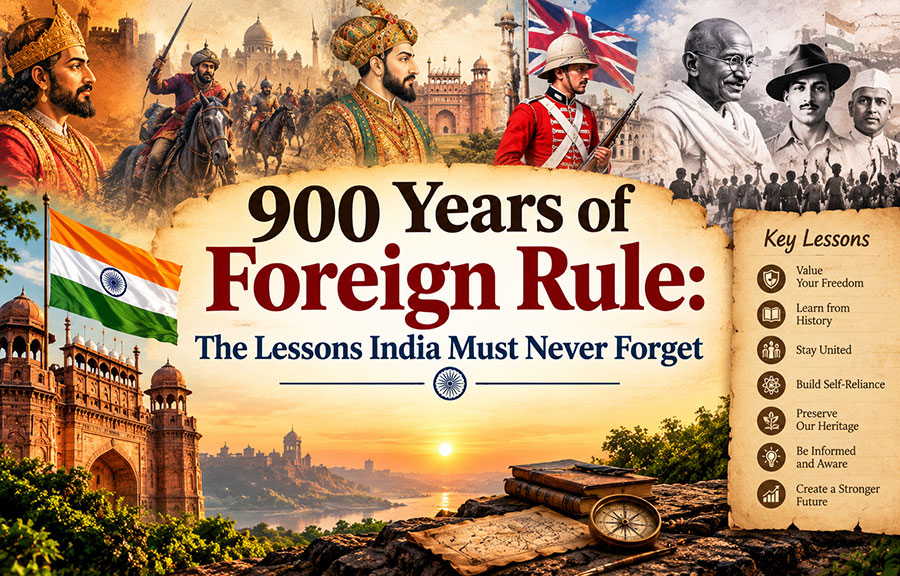
900 Years of Foreign Rule: The Lessons India Must Never Forget
The phrase “900 years of foreign rule” is often used to describe a long and complicated chapter of Indian history, but it should not be understood as one uninterrupted period under a single foreign power. The subcontinent experienced many different kingdoms, sultanates, empires, regional states and colonial administrations. Their authority varied by region and time, and Indian rulers, communities and institutions continued to shape events throughout these centuries.
Looking back is most valuable when history is approached with care: acknowledging conquest, exploitation and resistance without reducing centuries of people and cultures to a single story. The lessons are not about inherited hatred. They are about understanding how power works, protecting institutions, valuing cultural confidence and learning from the choices that shaped the past.
First, What Does “900 Years of Foreign Rule” Mean?
There is no single, universally agreed starting point for a neat 900-year timeline. From the late first and early second millennium onward, different parts of the subcontinent experienced incursions, migrations, new ruling houses and political change. The Delhi Sultanate emerged in the early thirteenth century; the Mughal Empire was founded in 1526; and the English East India Company gradually acquired territorial power in the eighteenth century before Crown rule began in 1858. British rule ended with independence in 1947.
These periods were not identical. Rulers developed local alliances, relied on Indian administrators and soldiers, and interacted with regional cultures in different ways. India was also never simply passive: regional powers rose, people resisted, and traditions changed through exchange as well as conflict. A useful history recognises both domination and the agency of people living through it. Harvard’s South Asian history chronology provides a helpful overview of the many political periods involved.
Lesson 1: Political Unity Needs Strong, Fair Institutions
Periods of intense rivalry among regional powers sometimes created openings for outside forces to intervene. The expansion of the East India Company was not inevitable, nor can it be explained by one cause alone. Company leaders exploited commercial privileges, military strength, diplomacy, revenue systems and conflicts among local elites. The Battle of Plassey in 1757 and the Company’s acquisition of revenue-collection rights in Bengal in 1765 were important turning points in this expansion.
The lesson today: cooperation and capable institutions matter. A country’s strength depends not only on military power but also on accountable leadership, public trust, effective administration and the ability to resolve disagreements without allowing them to be exploited.
Lesson 2: Economic Sovereignty Is as Important as Political Freedom
The East India Company began as a trading enterprise and developed into a territorial power. Under colonial rule, taxation, trade policy and control over resources were shaped to serve imperial priorities. These arrangements affected artisans, merchants, cultivators and local economies in different ways across regions and periods. The economic story is complex, but it makes clear that control over revenue and trade can become a source of political power.
The lesson today: economic resilience grows through education, productive enterprise, fair competition, strong local capabilities and transparent public policy. International trade can bring opportunity, but countries also need the skills and institutions to negotiate terms that serve their people.
Lesson 3: Divide-and-Rule Tactics Thrive Where Trust Breaks Down
Colonial authorities often used alliances, rivalries and administrative arrangements to expand or maintain control. Yet it would be misleading to claim that every conflict in Indian history was created from outside or that Indian society was ever completely uniform. Social, regional, religious and political differences existed long before colonial rule. Political actors could exploit those differences when it suited their interests.
The lesson is to recognise manipulation without blaming whole communities. Rumours, selective history and fear-based messaging can weaken public trust. Today, checking sources, listening across differences and refusing to treat neighbours as enemies are practical ways to protect social cohesion.
Lesson 4: Cultural Confidence Helps Communities Endure Change
India’s languages, philosophical traditions, literature, music, architecture, crafts and religious practices have been shaped across many centuries. Some sites and institutions experienced destruction or disruption; others were patronised, adapted or built during periods of changing rule. Cultural history is not a simple tale of uninterrupted continuity or total loss. It includes preservation, reinvention, exchange and debate.
The lesson today: preserve heritage through research, conservation, language learning, responsible tourism and support for craftspeople and artists. Cultural confidence is strongest when it is informed by evidence and respectful of the many communities that have contributed to the subcontinent.
Lesson 5: Resistance Takes Many Forms
Resistance to expanding imperial power took many forms: armed struggles by rulers and local communities, peasant and tribal uprisings, reform movements, public debate, journalism, education and organised political campaigns. The uprising of 1857 was a major challenge to Company rule. Later, the freedom movement grew through diverse approaches and leaders, including mass mobilisation, constitutional politics, revolutionary activity and non-cooperation.
India’s independence was achieved through the sustained efforts and sacrifices of people across regions and backgrounds. No single person, community or method explains the whole story. Remembering that breadth helps us understand both the courage of individuals and the importance of collective action.
Lesson 6: Education and Reliable History Protect the Future
History can be used to inspire learning, but it can also be simplified to provoke anger. Dates, sources and context matter. A responsible reader distinguishes between a documented event, an interpretation and a claim that has not been established. The same care should be applied to stories about rulers, temples, battles, taxation, social change and resistance.
- Compare more than one credible historical source where possible.
- Check the period, region and political context before drawing broad conclusions.
- Separate the actions of a ruler or administration from the identity of an entire community.
- Be cautious with viral posts that provide no sources or use dramatic claims without evidence.
- Encourage young people to ask questions and examine evidence rather than memorise slogans.
Learning history well does not weaken patriotism. It gives citizens a firmer foundation for understanding their country and making thoughtful decisions.
Lesson 7: Remember the Past Without Carrying Hatred Forward
Historical suffering deserves honest recognition. So do the achievements, everyday lives and creative work of people who lived through difficult periods. But people today are not personally responsible for every action taken by rulers who lived centuries ago. Collective blame turns history into a weapon and makes mutual understanding harder.
A mature approach honours those who resisted injustice, protects historical sites, supports scholarship and treats people today with fairness. It can be proud of India’s civilisational depth while remaining open to evidence and acknowledging that history contains complexity, conflict and cultural exchange.
A Short Timeline to Put the Story in Context
- Early medieval centuries: Numerous regional kingdoms and political powers developed across the subcontinent; there was no single all-India political arrangement.
- 1206 onward: The Delhi Sultanate became a major power in northern India, with its influence and territorial control changing over time.
- 1526: Babur’s victory at the First Battle of Panipat marked the beginning of the Mughal Empire.
- 1600: The English East India Company received its royal charter as a trading company.
- 1757 and 1765: Plassey and the grant of diwani rights in Bengal helped transform Company influence into territorial and revenue power.
- 1857–1858: A major uprising challenged Company rule; the British Crown assumed direct rule in 1858.
- 1947: British colonial rule ended as India became independent, amid the trauma and displacement of Partition.
This timeline is a starting point, not a complete account. Regional histories often followed different paths, and each date requires deeper context to understand its full significance.
What These Lessons Mean for India Today
History becomes useful when it informs present-day choices. Invest in education and historical research. Protect monuments and archives. Support local enterprise and innovation. Strengthen institutions that treat citizens fairly. Resist misinformation and political messaging that depends on communal suspicion. Encourage disagreement without dehumanisation.
National strength is not measured by how often the past is invoked, but by whether its lessons lead to a more informed, confident, just and resilient society. Remembering history should deepen our responsibility to one another, not narrow our sense of who belongs.
Frequently Asked Questions
Was India under foreign rule for exactly 900 years?
No single, exact 900-year period describes the whole subcontinent. The phrase is a broad popular shorthand. Different regions experienced different rulers and degrees of control, and political authority changed over time.
When did British rule in India begin?
British influence grew gradually. The East India Company was founded in 1600 as a trading company; its major political expansion followed victories and revenue rights in the eighteenth century. After the uprising of 1857, Crown rule began in 1858 and continued until independence in 1947.
Did all Indian kingdoms resist outside powers in the same way?
No. Rulers and communities made different choices depending on their circumstances. Some fought, some formed alliances, and some negotiated. Resistance also came from ordinary people, reformers and organised political movements.
What is the most important lesson from this history?
There is no single lesson, but the value of strong institutions, economic resilience, social trust, cultural preservation and informed citizenship stands out. Historical understanding is strongest when it is based on evidence and context.
How can students learn about this period responsibly?
Use school textbooks, university resources, archival materials and reputable historians. Compare interpretations, check dates and avoid posts that make sweeping claims without evidence. Studying different regional experiences provides a fuller picture.
Final Thoughts: Let History Build Understanding, Not Division
Centuries of political change in India include conquest, empire, cultural exchange, resistance and renewal. The phrase “900 years of foreign rule” captures a popular way of expressing a long historical experience, but it cannot replace the detailed story of the many societies and powers that shaped the subcontinent.
The lesson India must never forget is to protect freedom through informed citizens, strong and fair institutions, economic capability, cultural stewardship and unity that respects diversity. Remember the past honestly, study it carefully and use its lessons to build a better future.
Further reading: Harvard’s Timeline of South Asian History, Duke University Libraries: British India, and NCERT-based learning resource on the East India Company.